Every year the same student walks in. Bright, sincere, sitting with the phone face down, and still unable to stay with a ninety-minute lecture. By minute fifteen the eyes are on the screen and the mind is somewhere else. Then, with real shame, comes the line every teacher has heard: "Sir, mera focus hi nahi banta."
Here is what that student needs to hear first. Nothing is wrong with you. Your attention works exactly the way you have trained it to work.
What ten thousand swipes teach a brain
Think about what a short-video feed asks of you. Decide in two seconds whether this is worth your time. If yes, stay for thirty. If not, swipe. Repeat a few hundred times a day, every day, for years.
That is practice. Deliberate, daily, high-volume practice at one skill: judging fast and moving on. You have become very good at it. The trouble is only that a three-hour paper asks for the opposite skill.
My experience is what I agree to attend to.
William James, The Principles of Psychology (1890)
The numbers behind the feeling
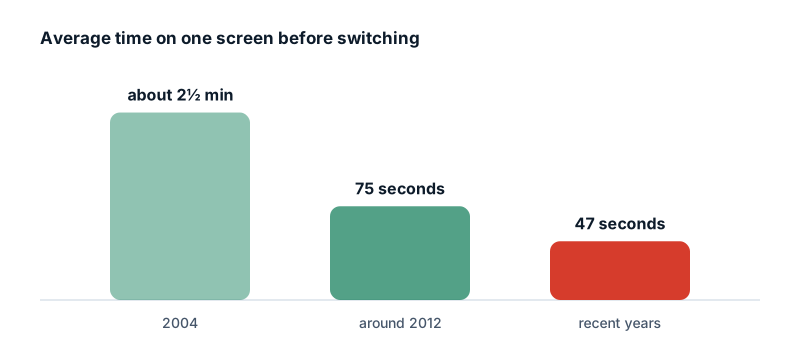
Gloria Mark, a professor at the University of California, Irvine, has been timing how long people stay on one screen before switching since 2004. In her first measurements the average was about two and a half minutes. Around 2012 it was 75 seconds. In recent years it has been about 47 seconds1.
A second finding is closer to home. In 2023, researchers in Munich gave sixty people a task that needed them to hold a plan in mind, interrupted them with TikTok, Twitter, YouTube or nothing, and then checked whether they still remembered what they meant to do. Only the short-video group got clearly worse2. It is one experiment and a small one, so read it as a warning light, not a verdict. But it matches what students describe: after a scroll session, the plan for the evening is simply gone.
And the phone does not even need to be in your hand. In a study of nearly 800 smartphone users, people who left the phone in another room did better on thinking tests than people who kept it on the desk, even when it was switched off3.
Why "just delete Instagram" fails
Advice that begins with "simply stop" has a poor record. A habit built over years does not vanish in a weekend, and a student who fails at quitting learns one more wrong thing: that they have no willpower.
There is a better question. If your mind has learned to take in one sharp idea in sixty seconds and then ask for the next one, what happens when the next one is the moment of inertia of a ring, and the one after that is the parallel axis theorem?
The habit is not the enemy. The content is.
Point the habit at the syllabus
This is the whole idea behind a concept reel. One idea. One minute or two. A clear picture, the formula, where students usually slip, and then a question so the idea has to come back out of your head.
It does not replace your class. A derivation still needs a quiet hour and a pen. What it replaces is the part of your day that was going to the feed anyway: the bus, the queue, the ten minutes before dinner.
The feed gives you | A concept reel gives you |
|---|---|
Something new every swipe | One idea from your own syllabus |
A reason to keep scrolling | A question to answer before you move on |
Nothing to show at night | A list of topics you now know |
Try this for three days
Pick one chapter you finished more than a week ago.
Before opening any other app in a free moment, watch two reels from it and answer the question after each.
At night, write the two ideas from memory in one line each. No peeking.
Three days is enough to feel the difference between scrolling that leaves nothing and scrolling that leaves a chapter.
Sources
Gloria Mark, interview with UC Newsroom, "How to sharpen your attention and meet your goals" (2024). universityofcalifornia.edu
Chiossi, Haliburton, Ou, Butz and Schmidt, "Short-Form Videos Degrade Our Capacity to Retain Intentions", CHI 2023. doi.org/10.1145/3544548.3580778
Ward, Duke, Gneezy and Bos, "Brain Drain: The Mere Presence of One's Own Smartphone Reduces Available Cognitive Capacity", Journal of the Association for Consumer Research (2017). doi.org/10.1086/691462