There is a moment in every revision session that feels wonderful. You open your notes on chemical bonding, read the page on hybridisation, and every line looks familiar. "Haan, yeh aata hai." You turn the page.
That feeling has a name among researchers, and it is not a compliment. It is the illusion of knowing. Recognising a line when you see it and producing it on a blank page are two different abilities. The exam only pays for the second one.
The experiment that settled it
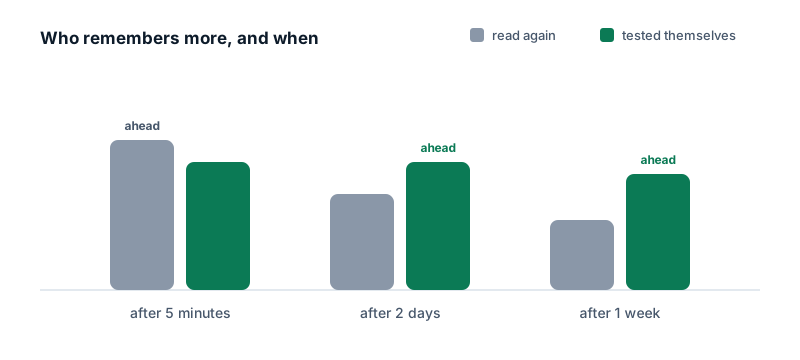
In 2006 two psychologists at Washington University, Henry Roediger and Jeffrey Karpicke, gave students a passage to learn. One group read it again and again. Another group read it once and then tried to write down everything they could remember, with no feedback at all.
Five minutes later, the rereaders did better. This is why rereading feels so good: it works beautifully for the next five minutes.
Two days later, and again a week later, it was the other way round. The students who had tested themselves remembered clearly more1.
Taking a memory test not only assesses what one knows, but also enhances later retention.
Roediger and Karpicke (2006)
It beats the clever methods too
Maybe rereading is just a weak opponent. So in 2011 Karpicke compared self-testing with something students are often told to do instead: drawing detailed concept maps with the text open. A week later, the students who had practised recalling still came out ahead, including on questions that needed them to connect ideas2.
And when a group of psychologists reviewed ten popular study methods in 2013, practice testing was one of only two rated as highly useful. Rereading, highlighting and summarising were rated low3.
If it feels easy, it is probably not revision.
Why pulling works better than pushing
When you reread, the answer is on the page and your mind only has to nod. When you try to recall, your mind has to go and find the answer, and the act of finding it makes the path to it stronger. A wrong attempt helps as well, as long as you check and correct it, because now you know exactly where the gap is.
What this looks like in practice
You do not need a question bank to start. You need to change the order of things.
Instead of | Do this |
|---|---|
Reading the formula list for rotation | Cover it, write every formula you can, then check |
Watching a solved example | Pause before the solution and try the next step |
Rereading the NCERT page on the cell cycle | Close the book and say the phases aloud in order |
"Revising" a chapter | Answering ten questions from it, then reading only what you missed |
Why every concept reel ends in a question
This is the reason a concept reel does not stop at the explanation. The minute of watching is the smaller half. The question that follows is where the idea has to come back out of your head, and that is the half the research is talking about.
It is also why previous-year questions matter so much. A PYQ is not only practice for the paper. It is the most honest retrieval test there is: the exam's own words, asking for the exam's own answer.
Two rules for this week
Never close a chapter without asking yourself five questions from it, with the book shut.
When you get one wrong, do not feel bad and move on. Write the right answer by hand once. That is the most valuable minute of the session.
Sources
Roediger and Karpicke, "Test-Enhanced Learning: Taking Memory Tests Improves Long-Term Retention", Psychological Science (2006). doi.org/10.1111/j.1467-9280.2006.01693.x
Karpicke and Blunt, "Retrieval Practice Produces More Learning than Elaborative Studying with Concept Mapping", Science (2011). doi.org/10.1126/science.1199327
Dunlosky, Rawson, Marsh, Nathan and Willingham, "Improving Students' Learning With Effective Learning Techniques", Psychological Science in the Public Interest (2013). doi.org/10.1177/1529100612453266