In October a student finishes Thermodynamics. Notes are neat, the questions at the back are done, the test goes well. In January the same student opens a mock paper, sees a question on entropy and feels the floor move. "But I did this chapter."
Yes. And you have done nothing wrong. You have only met the oldest result in the study of memory.
A man, a stopwatch and 1885
Hermann Ebbinghaus, a German psychologist, wanted to know how fast we lose what we learn. He memorised lists of meaningless syllables, waited, and measured how much effort it took to learn them again. He published the result in 18851.
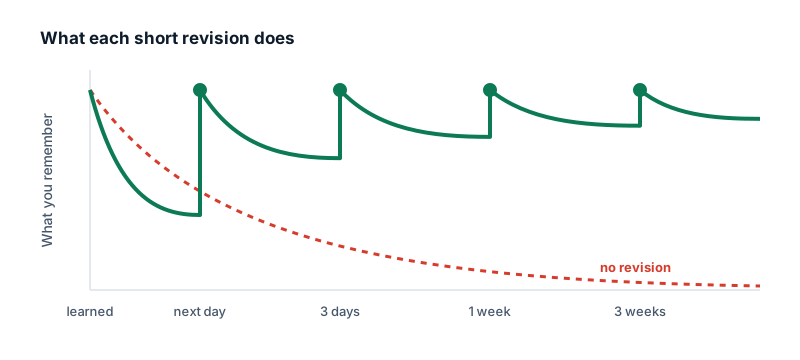
What he found has a shape. Memory does not fade at a steady pace. It falls quickly at first and then more and more slowly. Most of what you are going to lose, you lose early.
This is not a story from a dusty book. In 2015 two researchers in Amsterdam repeated the experiment, one of them spending seventy hours learning and relearning lists, and got a curve very like the original2.
The part students miss
The same experiments carry good news. Something you have learned and forgotten is much quicker to learn the second time. And each time you bring it back, it stays longer.
So the question was never "how do I stop forgetting". Nobody can. The question is "when do I come back".
Spread it out
A hundred years of experiments say the same thing about that: study spread over several short sessions is remembered far better than the same total time in one sitting. A large review of this research was published in 20063, and when psychologists rated ten common study methods in 2013, spreading practice over time was one of only two that earned the top rating4.
Rereading and highlighting, the two things most students do the night before, were rated low.
Five visits of five minutes beat one visit of an hour.
A schedule you can actually keep
Researchers do not agree on one perfect gap, and it depends on how far away your exam is. As a working rule for a chapter you have just finished, this is easy to remember and good enough:
Visit | When | How long |
|---|---|---|
First | The next day | 10 minutes |
Second | Three days later | 5 minutes |
Third | After a week | 5 minutes |
Fourth | After three weeks | 5 minutes |
After that | Once a month until the exam | 5 minutes |
Twenty-five minutes over three weeks. That is the whole price of keeping a chapter.
Why this is where short reels belong
Look at the "how long" column. Nobody opens a two-hour lecture for a five-minute visit. So the visit does not happen, and the curve does what it does.
A revision that is short by design removes that excuse. Two reels on entropy and one question, standing in a queue, is a real visit. Do that on the right days and October's chapter is still there in January.
Start tonight
Take the last three chapters you finished. Write today's date next to each. Tomorrow, give each one ten minutes and try to recall the main results before you look at anything. What you cannot recall is your revision list. It will be shorter than you fear.
Sources
Hermann Ebbinghaus, "Memory: A Contribution to Experimental Psychology" (1885), English translation. psychclassics.yorku.ca
Murre and Dros, "Replication and Analysis of Ebbinghaus' Forgetting Curve", PLOS ONE (2015). doi.org/10.1371/journal.pone.0120644
Cepeda, Pashler, Vul, Wixted and Rohrer, "Distributed practice in verbal recall tasks: A review and quantitative synthesis", Psychological Bulletin (2006). doi.org/10.1037/0033-2909.132.3.354
Dunlosky, Rawson, Marsh, Nathan and Willingham, "Improving Students' Learning With Effective Learning Techniques", Psychological Science in the Public Interest (2013). doi.org/10.1177/1529100612453266