Students often ask how hard the competition really is, and the answers they get are usually feelings: "bahut tough hai", "cut-off badh gaya". Feelings are a poor thing to plan a year around. The National Testing Agency publishes the actual numbers. Let us read them.
NEET, by NTA's own count
In July 2026 NTA released a document called "Key Data Points of NEET (UG) Over Years"1. This is the registration row from it.
Year | Candidates registered |
|---|---|
2019 | 15,19,375 |
2020 | 15,97,435 |
2021 | 16,14,777 |
2022 | 18,72,343 |
2023 | 20,87,462 |
2024 | 24,06,079 |
2025 | 22,76,069 |
2026 | 22,79,743 |
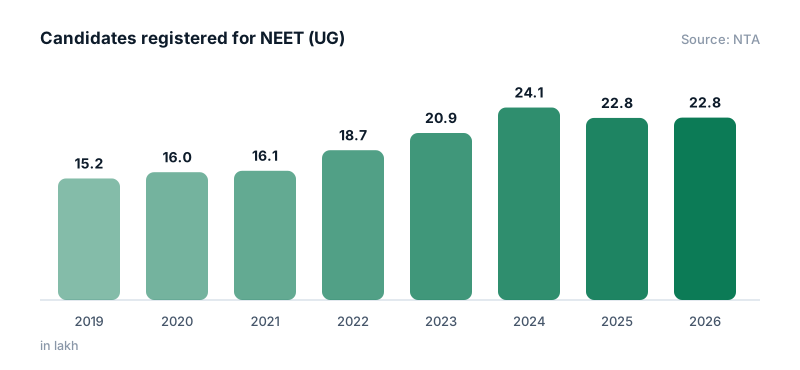
From 15.2 lakh to 22.8 lakh in seven years. In 2026, 19,99,895 of them actually sat the paper.
JEE Main, the same story
For the April 2026 session of JEE (Main), NTA's result notice records 11,10,904 candidates registered for Paper 1 alone, and notes that the paper was offered in thirteen languages2.
At the far end of that funnel, JoSAA's 2026 seat allocation closed Computer Science at IIT Bombay in the open category at rank 673.
What the numbers do not say
It would be easy to stop here and feel small. That is the wrong lesson, and a lazy one.
Look at what all those students have in common. The same NCERT. The same syllabus, published by the same agency. Broadly the same coaching material, the same previous-year papers, the same number of months.
When twenty lakh people study the same thing, having covered the syllabus is not an advantage. It is the entry ticket.
Everyone has finished the syllabus. Not everyone still has it on exam day.
Where ranks are actually made
Sit with any student after a mock test and go through the wrong answers. A few are from topics never studied. Most are from topics studied properly, months ago, and half-remembered now. The formula with the wrong sign. The exception in the periodic table that was "definitely revised".
Those are not gaps in learning. They are gaps in keeping. And because every serious student has learned the material, the keeping is where the marks separate.
This is why research on study methods keeps arriving at the same two habits: come back to material at spaced intervals, and test yourself instead of rereading. In a 2013 review of ten methods, those were the only two rated highly useful4.
A fairer way to measure your preparation
Stop asking "how much is done". Ask these instead.
Of the chapters I finished two months ago, how many could I take a test on today?
When did I last get a question wrong from a chapter I consider strong?
How many of my wrong answers this week were from old topics rather than new ones?
If the third number is high, more new chapters will not help. More returns to old ones will.
The small daily habit that answers this
You cannot give every old chapter an evening. You can give each one five minutes on the right days. That is what short concept reels and the question after each are for: a quick return to one idea, often enough that it is still there in May.
The crowd is real. So is the fact that most of it is revising the hard way.
Sources
National Testing Agency, "Key Data Points of NEET (UG) Over Years" (July 2026). neet.nta.nic.in
National Testing Agency, "Declaration of the Result/NTA Scores for JEE (Main) 2026 of Paper 1 (B.E./B.Tech.)", press release of 20 April 2026. jeemain.nta.nic.in
Joint Seat Allocation Authority, Opening and Closing Ranks 2026, Round 5. josaa.admissions.nic.in
Dunlosky, Rawson, Marsh, Nathan and Willingham, "Improving Students' Learning With Effective Learning Techniques", Psychological Science in the Public Interest (2013). doi.org/10.1177/1529100612453266