Ask a student how long they watched yesterday's recorded lecture and you get an honest answer and a wrong one. The honest answer is "the whole thing". The wrong part is the word "watched". The video played for ninety minutes. The student was there for the first few.
We do not have to guess about this. Somebody measured it.
The study
In 2014 three researchers, Philip Guo, Juho Kim and Rob Rubin, looked at how students actually watched lecture videos on edX, the online course platform started by MIT and Harvard. They had data from 6.9 million video watching sessions across four courses, which made it the largest study of its kind at the time1.
They asked a simple question: how long does a student stay with a video before leaving it?
What they found
Whatever the length of the video, the middle student stayed for at most about six minutes. A six-minute video was watched nearly to the end. A forty-minute video was also watched for about six minutes, and then most students were gone.
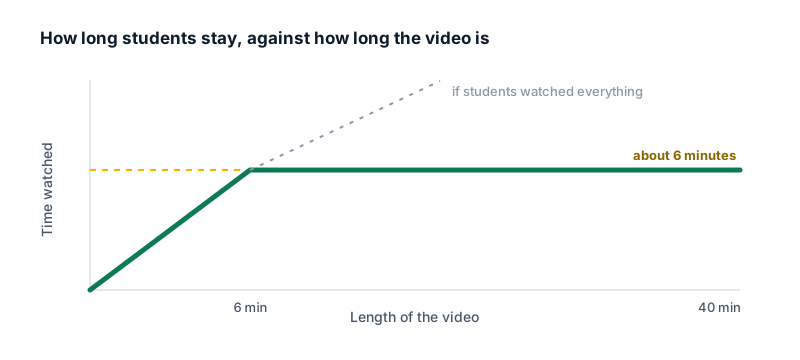
Shorter videos are much more engaging.
Guo, Kim and Rubin (2014)
Their advice to teachers was blunt: plan the lesson so that it can be cut into pieces shorter than six minutes.
It is not only about patience
It would be easy to read this as "students today cannot concentrate". The research on how people learn from pictures and words points somewhere kinder. When a lesson is delivered in small parts that the learner moves through, instead of one unbroken stream, people understand it better. Richard Mayer, whose work this is, calls it segmenting2.
The reason is simple once you see it. A new idea needs a moment to settle before the next one lands on top of it. A continuous lecture does not wait for you. A short piece does.
What this means on a Tuesday night
You have a two-hour lecture on electrostatics to revise before Sunday's test. There are two ways to do it.
Play the lecture again | Revise in pieces | |
|---|---|---|
Time | Two hours, in one sitting | Twelve pieces of five minutes |
When | Needs a free evening | Fits around everything else |
What you do | Watch | Watch one, answer one question |
What you find out | Nothing | Exactly which piece you could not answer |
The second way does not take less effort. It takes the same effort and puts it where it is needed.
A long video tells you that you were present. A short one tells you whether you understood.
How to cut any chapter into six-minute pieces
Write down every idea in the chapter that could be asked as a separate question. Gauss's law is one. The field of a ring on its axis is another.
For each, find or make one short explanation: the picture, the result, the one mistake people make.
Put one question after each. If you cannot answer it, that piece goes to the top of tomorrow's list.
This is exactly how a concept reel is built, and it is why each one carries a single idea rather than a chapter.
One caution
Short does not mean shallow, and it does not mean enough. Nobody learns to solve a rotational dynamics problem from a ninety-second clip. Your first meeting with a hard topic still needs a teacher, time and a notebook. The six-minute rule is about what happens after that first meeting: keeping what you learned, and finding what you lost.
Sources
Guo, Kim and Rubin, "How Video Production Affects Student Engagement: An Empirical Study of MOOC Videos", ACM Learning at Scale (2014). doi.org/10.1145/2556325.2566239
Mayer and Chandler, "When learning is just a click away: Does simple user interaction foster deeper understanding of multimedia messages?", Journal of Educational Psychology (2001). doi.org/10.1037/0022-0663.93.2.390