Try something. Read this number once and look away: 7 2 9 4. Easy. Now this one: 8 3 1 6 9 2 7 4 5 0 3 8. Unless you grouped it somehow, most of it is already gone.
You have just found the edge of your working memory, and that edge is the single most useful thing to understand about how to study.
The desk in your head
Working memory is where thinking happens. It is the small desk on which you hold the things you are using right now: the given values of a problem, the formula you just recalled, the step you are on.
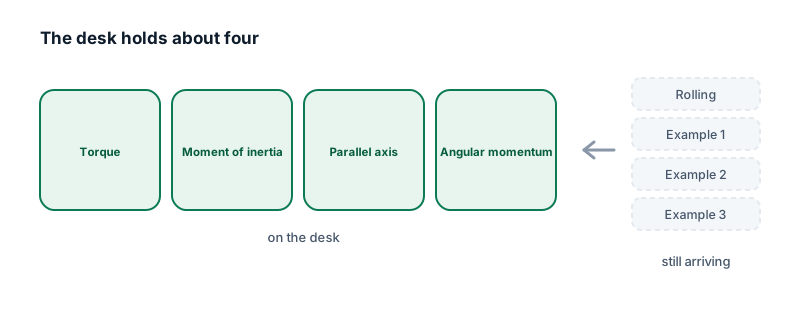
The desk is small for everyone. For a long time the textbook answer was "seven items". Careful work since then has brought the estimate down. Nelson Cowan, who reviewed the evidence in 2001, put it at about four chunks1.
Four. That is the desk you are working on when a teacher covers torque, angular momentum, moment of inertia, the parallel axis theorem, rolling without slipping and three solved examples before the bell.
What a full desk does
When more arrives than the desk can hold, nothing dramatic happens. You do not feel a crash. You keep listening, you keep nodding, and the new idea quietly pushes an older one off the edge before it was stored anywhere.
John Sweller described this in 1988 and gave it the name it still has: cognitive load. His point was that the struggle of holding too much at once is not the same as learning, and can get in its way2.
Feeling overloaded in a lecture is not a sign that you are slow. It is a sign that the desk is full.
How experts get around it
A good physics teacher also has a desk that holds four things. The difference is the size of each thing. For a beginner, "rolling without slipping" is five separate facts. For the teacher it is one. That is what a chunk is: several facts tied together so tightly that they take up a single place.
Chunks are built one at a time, and each one needs a little quiet to form. This is the real argument for learning in small pieces. It is not that students today cannot handle long content. It is that a chunk cannot be built while three other new ideas are queuing behind it.
One idea at a time, done properly
A concept reel is designed around that limit. It takes one idea and gives it the whole desk:
one picture, so there is something to see and not only something to hear
one result, stated plainly
the one mistake students make with it
one question, so the idea has to be used before the next one arrives
Then it stops. The stopping is the point.
Chunking a chapter yourself
Take Rotational Motion. Do not write "revise rotation" in your planner. Write the pieces.
Piece | The one line to own |
|---|---|
Torque | Force times the perpendicular distance from the axis |
Moment of inertia | How mass is spread about the axis, not how much there is |
Parallel axis theorem | Shift the axis, add M times d squared |
Angular momentum | Conserved when no outside torque acts |
Rolling without slipping | The point touching the ground is at rest for that instant |
Five pieces. Each one fits on the desk. Each one can be checked with a single question. And after a week, when torque and moment of inertia have become one chunk for you, the chapter that looked like a wall has turned into a short list.
Sources
Nelson Cowan, "The magical number 4 in short-term memory: A reconsideration of mental storage capacity", Behavioral and Brain Sciences (2001). doi.org/10.1017/S0140525X01003922
John Sweller, "Cognitive Load During Problem Solving: Effects on Learning", Cognitive Science (1988). doi.org/10.1207/s15516709cog1202_4