"There is no time for revision." It is the most common sentence in any batch after November, and it is true. Class runs till afternoon, the new chapter needs the evening, the test on Sunday needs Saturday. Where exactly is the old chapter supposed to go?
Not into a free hour. There is none. It goes into the gaps.
Count your gaps once
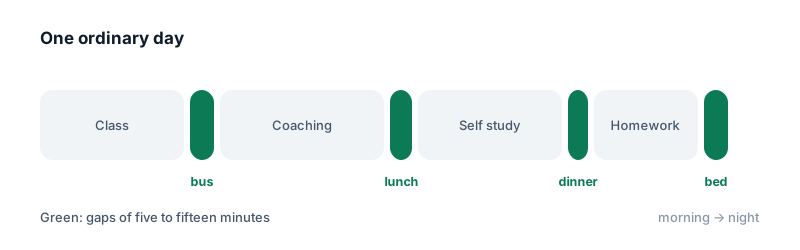
For one ordinary day, notice every stretch of three to ten minutes in which you were not really doing anything. Most students find a list like this.
When | About how long |
|---|---|
Waiting for the bus or auto | 8 minutes |
The ride itself | 15 minutes |
Before the teacher arrives | 5 minutes |
Lunch, after eating | 10 minutes |
Waiting for dinner | 7 minutes |
In bed, before sleep | 10 minutes |
That is close to an hour. It is already being spent, and you know on what.
Why gaps are better than a block
This is not a consolation prize. For keeping old material, short visits spread over days work better than one long sitting. Memory researchers have found this again and again for more than a century, and a large review of those experiments in 2006 came to the same conclusion1. When ten study methods were rated in 2013, spreading practice out was one of the two at the top2.
So the hour you do not have would have been the worse way to do it anyway.
A wealth of information creates a poverty of attention.
Herbert A. Simon (1971)
What fits in five minutes
A gap is too short for a derivation or a long numerical. Do not try. It is exactly right for these:
two concept reels from an old chapter, with the question after each
ten formulas written from memory on the back of your hand, then checked
five previous-year questions you got wrong last month
the reactions of one named-reaction family, said aloud
Notice that all four are recall, not reading. A gap spent rereading notes on a phone is a gap half wasted.
The trap in the same pocket
Here is the honest difficulty. The gap is where the feed lives. The thumb opens it before the mind has made any decision at all.
Two small changes do most of the work.
Move the feed off your first screen and put your revision there. You will open whatever is nearest.
Decide the night before which chapter tomorrow's gaps belong to. A gap with a plan gets used. A gap without one gets scrolled.
And for the hours when you sit down to solve problems properly, put the phone in another room. In a study of nearly 800 people, those who did that performed better on thinking tasks than those who kept the phone on the desk, even switched off3.
You do not need more hours. You need the gaps to belong to you.
A week of gaps
Six gaps a day, five days a week, one small topic per gap: thirty topics revisited in a week without touching your study hours. Over a term that is the difference between a syllabus you finished and a syllabus you still have.
Start with tomorrow's bus ride. One old chapter. Two reels. Two questions.
Sources
Cepeda, Pashler, Vul, Wixted and Rohrer, "Distributed practice in verbal recall tasks: A review and quantitative synthesis", Psychological Bulletin (2006). doi.org/10.1037/0033-2909.132.3.354
Dunlosky, Rawson, Marsh, Nathan and Willingham, "Improving Students' Learning With Effective Learning Techniques", Psychological Science in the Public Interest (2013). doi.org/10.1177/1529100612453266
Ward, Duke, Gneezy and Bos, "Brain Drain: The Mere Presence of One's Own Smartphone Reduces Available Cognitive Capacity", Journal of the Association for Consumer Research (2017). doi.org/10.1086/691462