Every plan to "use the phone less" fails in the same place: the first free minute. The hand has opened the feed before any decision was made. So this plan does not ask you to fight that minute. It asks you to redirect it.
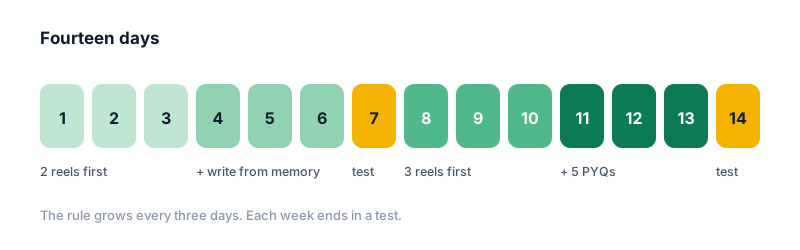
Fourteen days. No app deleted. One rule that grows a little each few days.
Why not just quit
Because quitting asks a tired seventeen-year-old to beat, by willpower alone, a product built by thousands of engineers to be opened. That contest has a known result.
Changing what the habit delivers is far easier than removing the habit. The cue stays the same: a free moment and a phone. The routine changes by two minutes.
Before you start: three small set-ups
Move every feed app off your home screen, into a folder on the last page. Put your revision on the first screen, where your thumb lands.
Each night, write tomorrow's chapter on a slip of paper and keep it with your phone. One old chapter, not a new one.
Choose a place outside your room where the phone will stay during problem practice. In a study of nearly 800 people, having the phone in another room, rather than on the desk, improved performance on thinking tasks even when it was off1.
The fourteen days
Days | The rule | What it builds |
|---|---|---|
1 to 3 | Before opening any feed, watch two concept reels from tomorrow's chapter and answer the question after each | The new first step |
4 to 6 | Same, and at night write those ideas from memory, one line each | Recall, not just watching |
7 | Take a ten-question test from the week's chapters | An honest score |
8 to 10 | Three reels before any feed. First gap of the day gets no feed at all | A longer run |
11 to 13 | Add five old previous-year questions in one gap each day | Exam-style recall |
14 | Repeat day 7's test with new questions. Compare | Proof |
What will happen, honestly
On day two you will forget and open the feed first. That is fine. Close it, do the two reels, open it again. The plan does not break when you slip. It breaks when you decide a slip means you have failed.
Around day five the reels will start to feel short and the question will be the interesting part. That is the change you are looking for: your mind has begun expecting to be asked.
By day ten you will notice something about the feed itself. After five minutes of content that leaves something behind, content that leaves nothing starts to feel thin.
My experience is what I agree to attend to.
William James (1890)
Why the tests on day 7 and 14 matter
Without them this is only a feeling. With them it is a measurement. Trying to recall is itself one of the most effective ways to make a memory last, far better than reading the material again2, so the two tests are not just a check on the plan. They are part of it.
Do not trust the plan. Trust the difference between your two scores.
After day 14
Keep the first rule forever: two reels and two questions before any feed. It costs four minutes. Everything else in this plan was scaffolding to make that one habit stand on its own.
You will still scroll. You will just have revised first.
Sources
Ward, Duke, Gneezy and Bos, "Brain Drain: The Mere Presence of One's Own Smartphone Reduces Available Cognitive Capacity", Journal of the Association for Consumer Research (2017). doi.org/10.1086/691462
Roediger and Karpicke, "Test-Enhanced Learning: Taking Memory Tests Improves Long-Term Retention", Psychological Science (2006). doi.org/10.1111/j.1467-9280.2006.01693.x