Two students take the same mock test on Sunday and both score 148. On Monday one of them is better prepared than before and the other is not. The difference was made on Sunday evening, in the half hour after the result.
One looked at the number, felt something, and closed the page. The other went looking for the reasons.
A score is a summary. You need the detail.
148 out of 300 could mean you are average at everything. It could also mean you are excellent in two subjects and losing thirty marks to four small topics. Those are completely different situations and they need completely different weeks.
The score cannot tell them apart. The wrong answers can.
The loop
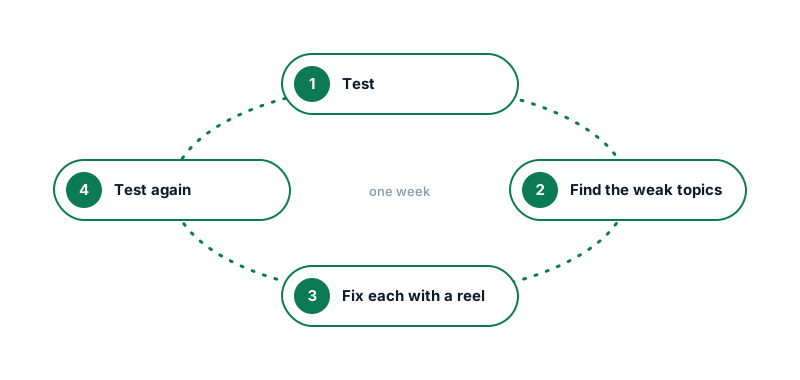
1. Test. A previous-year paper is best, because it is the exam's own judgment of what matters.
2. Find. Sort every wrong and every skipped question by topic, not by subject. "Chemistry" is not a weakness. "Hybridisation" is.
3. Fix. Take the three topics that cost you the most marks. For each, one short explanation of the idea and then two or three questions on it. Not the whole chapter again.
4. Test again. A week later, questions from those same topics. If you get them right, the topic leaves the list. If not, it stays.
Why sorting by topic changes everything
A wrong answer feels like one event. Sorted by topic, your wrong answers turn into a pattern, and patterns can be worked on.
What the result says | What the topic list says |
|---|---|
Physics: 42 out of 100 | Rotational motion: 0 of 3 right. Electrostatics: 3 of 3 |
Chemistry: 61 out of 100 | Lost 12 marks to Chemical Bonding alone |
19 wrong answers | 11 of them from five topics |
The right-hand column is a to-do list. The left-hand one is a mood.
Mix the retest
When you practise the weak topics again, do not do all the rotation questions, then all the bonding questions. Shuffle them.
In a well-known experiment, people learned to recognise painters' styles either one artist at a time or with the artists mixed together. Mixing produced better results on new paintings. The striking part is that most participants were sure the one-at-a-time method had worked better for them, even after their own scores showed the opposite1.
In the exam, nobody tells you which chapter a question is from. Practise the way you will be asked.
Why the fix should be small
After a bad test the instinct is to "redo the chapter". It feels serious. It is also why the loop usually dies: redoing three chapters takes a week, the next test arrives first, and the list only grows.
A weak topic is rarely a whole chapter. It is one idea that never settled. Fix the idea, check it with a question, and move to the next. This is what a concept reel is for, and it is why CORE's test analysis lists the topics behind your wrong answers, weakest first, with the reels for each.
Being tested is not only a way to measure this. Recalling an answer strengthens the memory of it more than studying the material again does2. The retest in step four is doing half the fixing.
Your next test
Before you look at the total, do three things.
Count wrong and skipped questions by topic.
Circle the three topics with the most marks lost.
Put a date, one week away, next to each.
Then look at the score, if you still want to.
Sources
Kornell and Bjork, "Learning Concepts and Categories: Is Spacing the 'Enemy of Induction'?", Psychological Science (2008). doi.org/10.1111/j.1467-9280.2008.02127.x
Roediger and Karpicke, "Test-Enhanced Learning: Taking Memory Tests Improves Long-Term Retention", Psychological Science (2006). doi.org/10.1111/j.1467-9280.2006.01693.x